From 2026, electronic invoicing will gradually become mandatory for all businesses in France.
This reform is not merely a change in format: it radically transforms the way invoices are issued, sent and tracked.
Behind this development, one question often arises: how can organisations achieve compliance without making their operations more complex?
French companies will have to switch to electronic invoicing starting from
september 1, 2026
An electronic invoicing reform that is changing practices
Until now, sending an invoice in PDF format by email was sufficient in most cases. With the electronic invoicing reform in France, this way of working is changing.
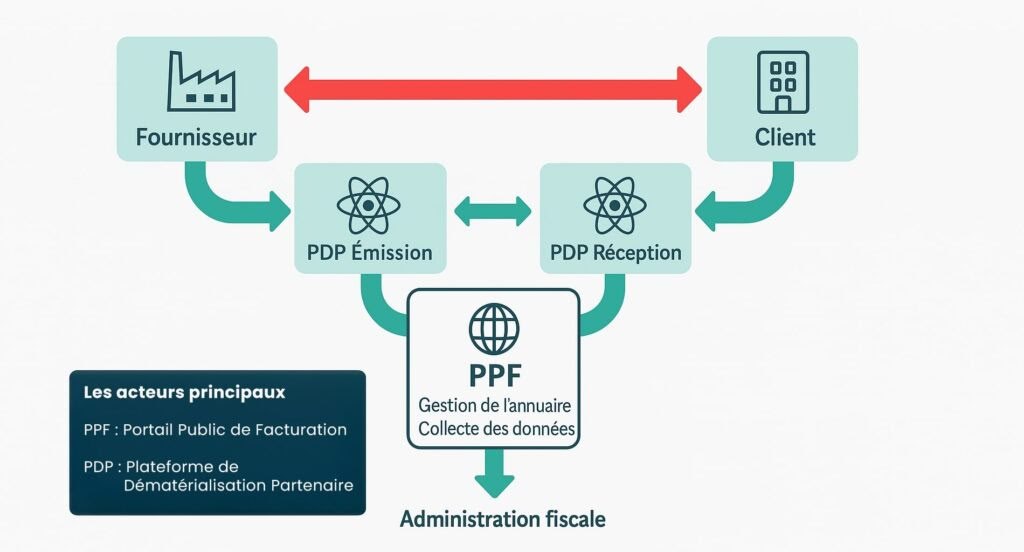
From now on, invoices must be issued in structured formats and transmitted through certified platforms called PDPs (Partner Dematerialization Platforms). These platforms will also be responsible for transmitting certain data to the tax authorities.
This change does not only concern the format of invoices. It also involves an evolution of the tools and processes used on a daily basis.
Where do you stand today?
In just a few minutes, you can assess your situation and anticipate the changes ahead.
PDP: A mandatory step for businesses
In this new framework, PDPs become a central component. They handle the sending and receiving of electronic invoices while ensuring compliance and the transmission of the required information to the tax authorities.
All companies will need to go through a PDP to remain compliant.
That’s why choosing the right solution becomes strategic. A poor decision can lead to additional complexity in day-to-day management.
The risk: adding more tools and making management more complex
Faced with this reform, a first approach is to add an external platform to your existing system. This often involves using multiple tools connected to each other through connectors.
While this solution may meet regulatory requirements, it can quickly become difficult to maintain. Data exchanges multiply, manual operations increase, and so do the risks of errors.
In the long run, this type of setup can significantly burden administrative management.
Electronic invoicing with Odoo: an integrated approach
Another approach is to integrate electronic invoicing directly into your management system. This is the approach offered by Odoo.
With Odoo, invoices are created, sent, and tracked within a single environment. This integration helps avoid process breaks and duplicate data entry.
Data flows seamlessly between invoicing and accounting, simplifying tracking and reducing manual tasks.
What if you simplified your management starting today?
Anticipating the reform is also an opportunity to save time today.
Odoo and PDP certification: towards a complete solution
To meet the requirements of the reform, Odoo is evolving towards PDP certification. This development aims to enable companies to manage the entire electronic invoicing process directly from their system.
Ultimately, this will include:
- the issuance and receipt of compliant electronic invoices
- the management of structured formats (such as Factur-X or UBL)
- the automatic transmission of data to the public portal (PPF)
- invoice status tracking
This integration reduces the need for additional tools and simplifies compliance.
Simplify your processes rather than multiplying them
Faced with the reform, two approaches clearly stand out. The first relies on adding external solutions, leading to a multiplication of tools and interfaces. The second favors integration within a single system.
It is this second approach that improves clarity and efficiency. By centralizing management, companies reduce manual operations and enhance the reliability of their data.
Why anticipate electronic invoicing now
Waiting until it becomes mandatory can lead to decisions being made in a rush. This limits your options and increases the risk of choosing an unsuitable solution.
On the contrary, anticipating allows you to take the time to structure your organization, choose a consistent tool, and prepare your teams smoothly.
Implementing a solution like Odoo can therefore be done progressively, while already delivering immediate benefits in terms of management.
Are you ready for electronic invoicing in 2026?
In just 30 minutes, you can:
- understand the impact on your business
- identify the right decisions
- avoid common mistakes
Odoo: an opportunity, not just a requirement
Electronic invoicing should not be seen merely as a regulatory constraint. It can become a lever to improve your organization.
By centralizing your processes, automating certain tasks, and reducing manual operations, Odoo enables you to turn this requirement into a real opportunity.
Get support for a smooth transition
Every company has its own specificities, tools, and constraints. It is therefore important to adopt an approach that is tailored to your situation.
We support you with:
- understanding the impact of the electronic invoicing reform
- implementing Odoo in a way that aligns with your business
- helping you become autonomous in using it
The objective is simple: to help you become compliant while simplifying your day-to-day operations.
Conclusion: anticipate to stay in control
The electronic invoicing reform in France marks an important step in the digitalization of businesses. It introduces new requirements, but also creates opportunities.
By choosing an integrated solution like Odoo, it is possible to meet regulatory requirements while improving your organization.
Anticipating today means choosing simplicity for tomorrow.
FAQ – Electronic Invoicing and Odoo
No, with the reform, invoices will need to be transmitted in a structured format via a PDP.
Une Plateforme de Dématérialisation Partenaire est un service certifié qui permet d’envoyer, recevoir et transmettre les données de facturation à l’administration.
Odoo is a free PDP. For other PDPs, costs vary: many use a credit-based system or charge per document sent or received. Since some companies send thousands of documents per year, the cost can quickly add up.
Yes, Odoo is evolving to integrate these requirements.
The goal is precisely to limit the number of tools by integrating electronic invoicing directly into Odoo.
PEPPOL is an electronic invoicing exchange network. In Odoo, it is directly integrated and free, allowing you to send and receive invoices at no additional cost. It facilitates exchanges, but does not replace a PDP, which is mandatory in France to comply with the reform.